
Recently, news that global home furnishing giant IKEA announced the closure of seven stores in China has added another layer of anxiety to today's pressured home furnishing industry.
Behind this strategic contraction are shrinking demand caused by the downturn in real estate, online channels squeezing the survival space of offline stores, and the impact of changing consumer habits on business formats. These industry pains faced by almost all home furnishing companies are forcing practitioners to make a choice: should they shrink their fronts and defend the existing market, or actively break through and seek incremental growth?
In the same cyclical wave of the home furnishing industry, Chinese local leader Red Star Macalline has given a completely different answer. Instead of choosing to slim down, it has leveraged its abundant site resources to enter the already fiercely competitive automobile sector against the trend, trying to open a new growth curve through cross-industry expansion.
However, entering the automobile track was not an impulsive decision by Red Star Macalline. It was the result of four years of thinking and decision-making across multiple stages: a pilot exploration in 2020 when the Chongqing Erlang Mall introduced a high-end used car trading center; the strategic launch in 2023 when the group defined automobiles as an ecological extension; the formal breakthrough in September 2024 when the first "Pi Space" store opened at Chengdu Jialing Mall; and the scale expansion after the 3100 Strategy was released at the end of 2024, namely 1. million square meters of automobile area within three years, with projects launched in Wuhan Etouwan, Kunming dual malls, Xining Haihu, Xi'an Supreme Mall, Chongqing Euro Auto Port, and other locations.
Red Star Macalline's cross-industry move first came from self-rescue. In the home furnishing industry, which is deeply tied to real estate, breaking away from the impact of the real estate cycle, finding new growth points, and crossing the boundaries of business formats became unavoidable questions for Red Star Macalline. On the other hand, the automobile industry in recent years, especially the new energy sector, has been full of vitality. China has ranked first globally in new energy vehicle production and sales for many consecutive years, the market continues to expand, and more consumers are turning their attention to new energy vehicles that are more intelligent and experience-oriented when buying cars.
Zhu Jiagui, executive president of Red Star Macalline Home Furnishing Group, said frankly: "Knowing there are tigers in the mountain, we still head toward the mountain. Along the strategic extension of the '3+ Star Ecosystem,' meaning the integration of home furnishing, home appliances, and home improvement, we continue to explore more innovative business formats, and automobiles have become an inevitable strategic extension of the '3+ Star Ecosystem.'"
In his view, entering the automobile sector is an inevitable path and also a rational decision based on user needs: "The core is still the reconstruction of a business model for the 'people-car-home' scenario based on the 3+ Star Ecosystem, the exploration of user value under home consumption scenarios, and the creation of a strong service platform."
01
Red Star Macalline Is Experienced in Cross-Industry Expansion
This seemingly impossible cross-industry move had actually already been verified by Red Star Macalline through its extension from home furnishings and building materials into home appliances.
In the past, the home appliance market was divided among Gome, Suning, and JD.com, and the channel structure seemed unbreakable. In Zhu Jiagui's words, online channels were dominated by giants such as JD.com and Alibaba, while traditional offline channels were gradually declining. Yet new brands continued to emerge in the household appliance field, and Red Star Macalline used the "home scenario" as an entry point to force open a gap in the home appliance market.
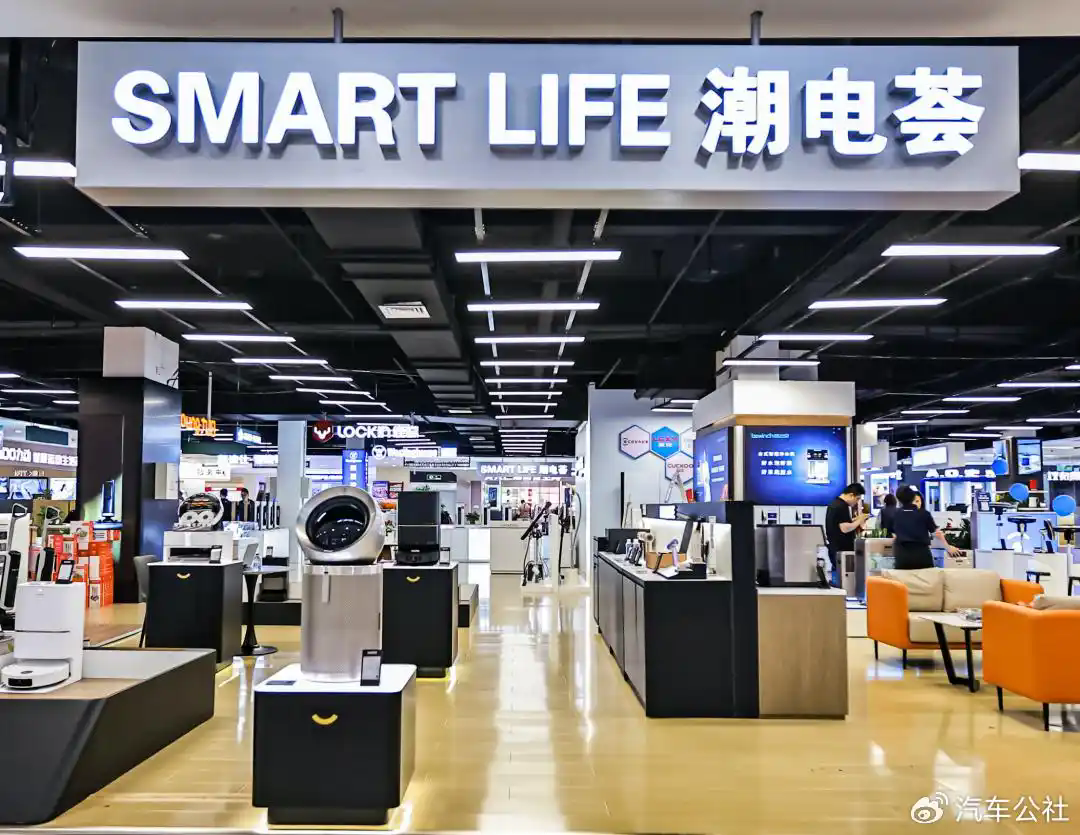
By the end of 2024, Red Star Macalline had built more than 150 smart appliance lifestyle halls in 115 core cities, with operating area exceeding 1.5. million square meters and accounting for 10%. The first Shanghai Mega-E Smart Electric Oasis store received 3,995 orders in just one month of trial operation, with average transaction value exceeding RMB 10,000, verifying the conversion efficiency of high-end scenarios and high-net-worth customer groups.
Data from AVC shows that in November 2025, Red Star Macalline's average home appliance transaction value reached RMB 14,900, RMB 4,843 higher than the average of traditional offline retail stores, with a premium index of 2.0. Meanwhile, its bundle purchase index, the proportion of multiple home appliances purchased by a single customer, reached 3.9, far exceeding the industry average of 2.1. This means its customer base is more inclined to purchase a full set of high-end home appliances in one stop, which highly matches the "quality demand" of home furnishing consumption. Leading brands such as Gree and Ecovacs have successively made it a core platform for regional market expansion.
This transformation gave Red Star Macalline strong confidence to enter the automobile track. In Zhu Jiagui's view, the current automobile ecosystem is recreating the "Warring States" pattern of the electrical appliance industry 25 years ago, with multiple business formats and a surge in operators, bringing unlimited possibilities for innovation.
Those familiar with the automobile industry should know that with changes in consumer habits and the strengthening of intelligence and experience, today's automobile retail industry is undergoing subtle changes and showing a new transformation toward appliance-like, supermarket-like, and ecosystem-oriented models.
"Smart electric vehicles are increasingly converging with electrical appliances in product attributes. Both are newer intelligent connected devices in consumers' lives."
"The traditional 4S store model can no longer meet everyone's consumption experience and needs. Consumers need one-stop comparison and purchasing to reduce decision-making costs, so more and more multi-brand collection stores have emerged."
"Simply selling cars is no longer enough. User needs must be met through scenario experiences and ecosystem integration, and automobile sales have also been upgraded into full-cycle consumption solutions covering purchase, use, maintenance, detailing, and car owner clubs."
...
Although Zhu Jiagui and Red Star Macalline are still newcomers in the automobile field, they have keenly sensed from customer purchasing behavior and decision-making that new energy vehicle sales channels are undergoing an irreversible transformation in these three directions, and automobile retail is also reaching a historical turning point from specialty stores to comprehensive retail venues.
From home furnishings to home appliances, Red Star Macalline has relied not on price wars, but on scenario integration and accumulated users. This logic is now being replicated in the automobile sector.
02
Three Advantages Help Solve Automobile Retail Challenges
As a company whose core business is selling home furnishings, Red Star Macalline's confidence in selling cars first comes from its advantages in space and cost. Red Star Macalline has more than 300 malls in over 200 cities nationwide, and the high-quality property conditions of its self-operated malls are a major asset. These malls are strictly selected, aligned with urban development directions, convenient in transportation, and equipped with ample parking space, making them highly suitable for the development of the automobile ecosystem.
After one year of development, Red Star Macalline's automobile business format now covers 46 cities, with operating area exceeding 320,000 square meters. Phase I of Wuhan Etouwan Automobile Plaza alone exceeds 40,000 square meters. Chongqing Erlang Mall has set aside 20,000 square meters for an automobile-themed space, while the two Kunming venues opened simultaneously to create a 20,000-square-meter automobile hall, far larger than ordinary shopping mall showrooms.
More importantly, there is the cost advantage. A 50-square-meter showroom in a high-end shopping mall costs RMB 400,000 in monthly rent. Although foot traffic is high, efficiency and lead volume are very low. Some brands have already positioned such spaces as advertising spots, while other brands and dealer investors cannot afford the burn rate and have chosen to exit shopping malls.
By contrast, although Red Star Macalline has relatively mid-frequency foot traffic, the visitors who do come are high-net-worth groups with clear purchase intentions. In addition, thanks to its directly operated malls, rent can be reduced exponentially. Especially in first-tier cities such as Beijing and Shanghai, first-floor rent is only one half to one third of that in shopping centers, perfectly matching the needs of automobile channels for a "lighter" transformation and cost considerations.
Second, Red Star Macalline's user ecosystem naturally fits automobile consumption. The core of automobile consumption is the connection with people, and Red Star Macalline holds a large base of high-net-worth members. Most of these users are on the path of buying a home, decorating it, and upgrading to a quality lifestyle. After completing home decoration and furnishing, they often face needs for car replacement or additional vehicle purchases.
"Under the premise of being user-oriented, our cooperation methods are more open and diversified. We hope to work with more partners focused on household user operations to explore the 'people-car-home' scenario together and meet the needs of families under home consumption scenarios," Zhu Jiagui said, pointing out the core logic of user synergy.
The seamless connection between "home" and "car" consumption scenarios has turned Red Star Macalline from a "home furnishing mall" into a traffic pool integrating cars and homes. The traffic diversion design of Chongqing Erlang Mall is an example: consumers in the home furnishing area can reach the automobile showroom directly by escalator, and after buying a car, they can naturally continue visiting the home furnishing area, forming two-way traffic flow.
Third, its model innovation fits industry trends. Current automobile channels are becoming more diversified, but each has shortcomings: 4S stores are asset-heavy, shopping mall stores offer a single experience, and online channels lack offline support.
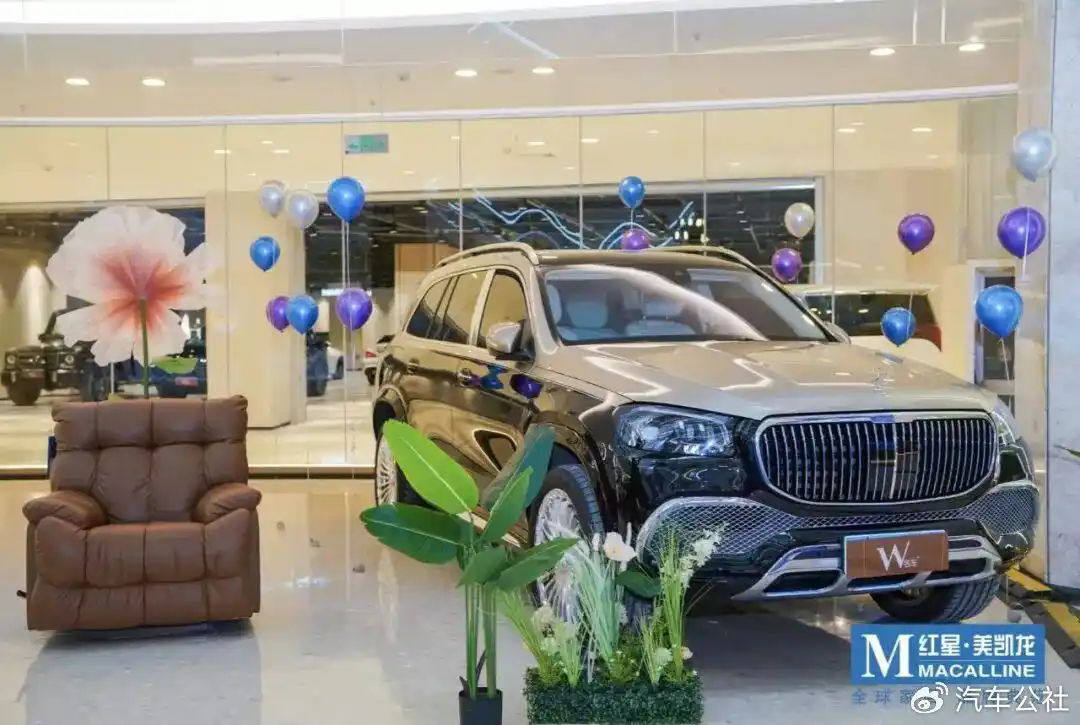
The "full-scenario automobile lifestyle complex" created by Red Star Macalline precisely makes up for these deficiencies. It not only displays new cars, but also lays out after-market services such as used cars, maintenance, charging, and battery swapping, forming a complete closed loop. At Shanghai Hunan Mall, Red Star Macalline and Ford Beyond jointly built an "Outdoor Off-Road Lifestyle Home" targeting circle-based operations. In Wuhan Etouwan, it created the "most beautiful registration service station" to realize a full-chain service loop. At Wuhan Hanxi Mall, it partnered with "Xiao Hu Talks Cars" to create an experience venue for automobile detailing and personalized modification. On Kunming Fengyuan Road, the W Famous Car Hall has become a reception room for high-end business socializing...
Zhu Jiagui said that this model is by no means about subverting tradition. Its underlying logic is "creating spaces and empowering partners": "Red Star Macalline does not want to be a disruptor of automobile channels, but an innovator in scenario ecosystem integration. Through its own 'super users,' 'super malls,' and 'super traffic,' and through joint marketing that integrates cars and homes, we launch customized packages and automobile lifestyle festivals, deeply binding automobile consumption with home life and shifting from single sales to ecosystem operations. We also do not sell cars directly with a heavy-asset model. Instead, we choose collection-store partners with multi-brand operation capabilities, user service thinking, and localized resources, bringing together a group of operators with new momentum and new models to jointly create an ecosystem." In the RMB 5. trillion automobile ecosystem, Zhu Jiagui hopes to obtain a rightful market share by improving the ecosystem.
03
A Brighter Prospect Appears After the Difficulties
Judging from actual implementation, this cross-industry move has already begun to show results.
As of the third quarter of 2025, Red Star Macalline's automobile business format had cooperated with more than 30 brands, and its share of operating area continued to increase. Chongqing Euro Auto Port has gathered more than 30 brands including NIO and Li Auto, becoming a popular regional automobile consumption destination. The dual Kunming venues became the largest automobile-themed halls in Southwest China upon opening.
Within one year, Red Star Macalline has expanded its automobile retail business area to 320,000 square meters, which indirectly confirms automakers' urgent composite demand for low-cost customer acquisition, brand exposure, and sales lead conversion.
According to its plan, future malls will form a clear business structure. Zhu Jiagui revealed that furniture, building materials, and home appliances, as Red Star Macalline's main businesses, must account for no less than 70% of operating area. In addition to focusing on upgrading its main business, Red Star Macalline is also extending the boundaries of industrial services around home life and plans to use 10% of operating area to explore innovative business formats including automobiles and catering. As a core emerging sector, automobiles aim to reach 1. million square meters of operating area within three years and grow into half of the new business formats.
Liu Wenji, vice president of the China Automobile Dealers Association, once said: "The core of channel transformation is quality improvement and efficiency optimization." Red Star Macalline's entry has brought new ideas to the highly competitive automobile industry. It does not copy traditional models, but combines its own advantages in space, users, and cost with the needs of the automobile industry, creating a differentiated path. From home furnishings to home appliances and then to automobiles, Red Star Macalline's transformation logic has always been clear: extend around "home" and break through through scenario integration.
For the automobile industry, this may look like a disruption, but in fact it provides a new possibility for automobile retail. OEMs can find low-cost and highly precise channels; dealers can relieve rent pressure and connect with high-potential users; and consumers can gain a car-buying experience that offers one-stop comparison, greater peace of mind, and time savings.
"A brighter prospect appears after the difficulties!" During the years of leading this transformation, Zhu Jiagui has used this phrase to describe Red Star Macalline's mindset in transforming into automobile retail. As the "people-car-home" ecosystem further integrates, Red Star Macalline's cross-industry story may bring more surprises to the automobile industry. Its transformation path also offers an important insight for all industries trapped in intense internal competition: by extending the ecosystem around core users, new growth space can always be found.
Source: Auto Commune
Back to List >>Call Soonfor
Sales: 400-1166-002
After-sales: 0769-22364912 Ext. 200

Back to Top
|
Free Consultation
|
Online Support
|
Submit Request |