

Smart home products are currently selling well, but pseudo-intelligence appears frequently. Some products, such as robot vacuums and smart washing machines, exaggerate their functions and suffer from gaps in user experience and device incompatibility. Faced with various products in the market claiming to be smart, consumers are not only checking reviews when purchasing, but also beginning to pay attention to whether the manufacturers behind the products are reliable.
By checking a company's business registration information, consumers can quickly understand its business scope and operating status. By using Tianyancha's risk function, they can further check whether the company has administrative penalties or consumer litigation records caused by false advertising or product quality problems, adding another layer of protection for avoiding gimmicky products and choosing trustworthy manufacturers.
Pseudo-intelligence in smart homes appears as functional gimmickry, fragmented experience, and hollow technology, becoming a stumbling block to high-quality industry development.
However, a new national standard for smart home appliances will be implemented on May 1, 2026. It clearly defines smart home appliances and sets five intelligence levels and nine types of typical application scenarios. The implementation of the new national standard means higher requirements for enterprises' research and development capabilities, quality control systems, and talent reserves.
Meeting standards and delivering a truly intelligent experience cannot be separated from professional research and development and product teams. Whether an enterprise is introducing top talent or a partner is evaluating the other party's technical strength, using employment information and key personnel queries to understand the professional background, past project experience, and industry networks of an enterprise's core technical personnel and product managers has become an important reference for assessing whether it can keep up with standards and achieve real innovation.
Data from Tianyancha Professional Edition shows that, as of now, China has more than 118,000 smart home-related enterprises that are currently operating or existing. Among them, more than 4,800 related enterprises were newly registered in 2025.
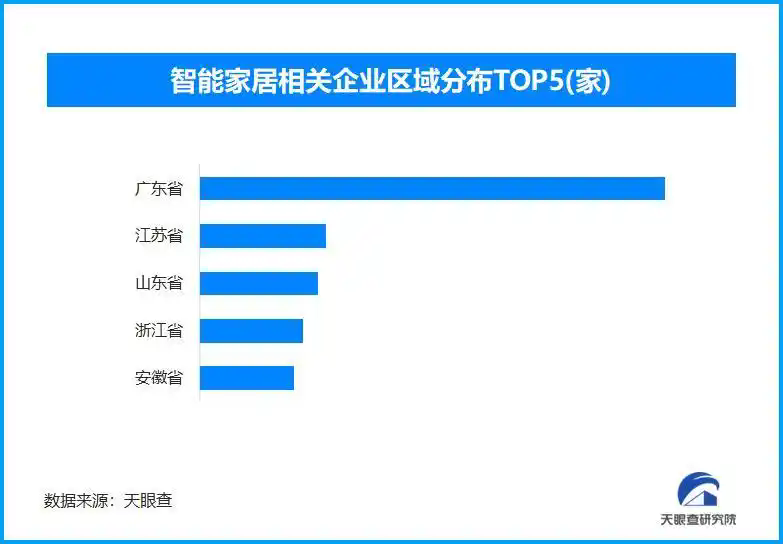
From the perspective of regional distribution, Guangdong Province ranks first in the number of smart home-related enterprises, with more than 35,000 related enterprises, accounting for 29.97 percent of the national total. It is followed by Jiangsu, Shandong, Zhejiang, and Anhui provinces.
Source: China News Service Jingwei
Back to List >>Call Soonfor
Sales: 400-1166-002
After-sales: 0769-22364912 Ext. 200

Back to Top
|
Free Consultation
|
Online Support
|
Submit Request |