

Project order delivery is repeatedly delayed. How can APS advanced scheduling connect design, procurement, and production? In today's fast-paced and highly competitive manufacturing environment, project-type orders such as customized equipment, non-standard production lines, and industrial assemblies frequently suffer delivery delays. Customer pressure, internal blame, inventory buildup, and soaring costs often stem from fragmented information and lagging coordination among design, procurement, and production. How can enterprises break departmental walls and achieve efficient end-to-end collaboration? The answer is to introduce an APS advanced scheduling system and connect the full chain from design to procurement to production.
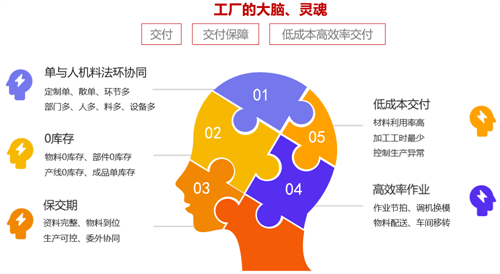
I. Pain Point Analysis: Why Are Project Orders Always Delayed?
Project orders are different from standard products. They are highly customized, have complex BOM structures, depend heavily on materials, and involve constantly changing process routes. Under traditional management models:
On the design side, drawings are revised repeatedly but changes are not synchronized to procurement and production in time.
On the procurement side, purchasing relies on experience or static BOM, making it impossible to respond dynamically to design changes or capacity fluctuations.
On the production side, scheduling relies on Excel and manual dispatching, so rush orders, material shortages, and equipment conflicts happen frequently and plans become meaningless.
The result is simple: one change at the front end creates three days of chaos at the back end, delivery cycles become uncontrollable, and customer satisfaction keeps falling.
II. The Breakthrough: APS Advanced Scheduling Is Not Just a Scheduling Tool, but a Collaboration Hub
APS, or Advanced Planning and Scheduling, is far more than a production scheduling tool. With real-time data and multi-constraint optimization algorithms, it becomes an intelligent collaboration engine connecting design, procurement, and production.
1. The design side: from static output to dynamic input
Once design is completed, structured BOM and process routes are generated and pushed automatically to APS.
If a design change occurs, such as replacing a motor model, APS immediately triggers recalculation of material demand, warnings on procurement planning, and resequencing of production processes. This makes design the true starting point of planning and eliminates information delays.
2. The procurement side: from experience-based estimates to demand-driven planning
Based on accurate labor hours, which can integrate GST standard hours, and backward scheduling from delivery dates, APS calculates the material demand time window for each process. Combined with ERP inventory, supplier lead time, minimum order quantity, and other constraints, it automatically generates phased delivery plans. For example, if a project order needs special steel, APS can lock the procurement window seven days in advance and avoid production stoppage caused by waiting for material. Effect: material shortage rates drop by more than 50 percent, and inventory turnover improves by more than 30 percent.
3. The production side: from rough scheduling to minute-level response
APS considers equipment capability, team skills, material readiness, and customer priority. It dynamically generates daily work plans that are feasible, executable, and traceable. Rush orders, rework, and equipment failure can all trigger full rescheduling within five seconds, while the system evaluates the impact on other orders at the same time. Effect: plan achievement rate rises from 60 percent to 90 percent, and delivery cycles are shortened by more than 25 percent.
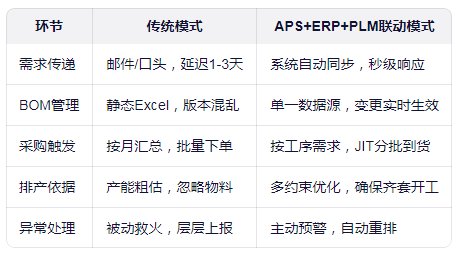
III. Closed-Loop Collaboration: Build an Integrated Digital Flow Across Design, Procurement, and Production
IV. Implementation Advice: A Three-Step Approach to Digital Collaboration
Connect the system foundation and make sure PLM for design, ERP for procurement and inventory, MES for production, and APS can exchange data. Build a standard process library by accumulating process steps, labor hours, and material templates for typical project orders to accelerate scheduling of new orders. Set collaboration rules, such as requiring procurement locking within 48 hours after design freeze, and use process rules to solidify collaboration.
V. Soonfor Software: Focused on APS Collaboration Solutions for Manufacturing
In response to difficult project-order delivery scenarios, Soonfor Software has worked deeply in manufacturing digitalization for many years and provides an integrated platform that combines APS advanced scheduling, ERP, and MES. It is especially designed for non-standard manufacturing, project-based production, and engineering delivery, making it possible for design changes to trigger procurement and production rescheduling automatically, for capacity to be modeled accurately based on GST standard labor hours, for multiple factories, projects, and resources to be optimized intelligently, and for delay risks to be exposed clearly through visual Gantt charts and warning dashboards. This allows every project order to rely not on people watching people, but on system-level collaboration. Conclusion: delays in project orders are not simply an execution problem, but a system collaboration problem. Only by using APS advanced scheduling to connect design, procurement, and production can manufacturers truly achieve a new model of on-time delivery, flexible response, and cost reduction with efficiency improvement. Choosing a professional partner like Soonfor Software can turn your delivery capability into a core competitive advantage.
Back to List >>Call Soonfor
Sales: 137-1208-6729
After-sales: 400-1166-002

Back to Top
|
Free Consultation
|
Online Support
|
Submit Request |