

Under the wave of intelligent manufacturing and digital transformation, more and more manufacturing enterprises have realized that one system alone cannot solve overall problems. The four major systems ERP, MES, APS, and CRM are like the brain, hands and feet, dispatcher, and customer window of enterprise operations. Only by achieving deep data connectivity can enterprises truly connect the full chain from customer demand to production delivery.
In reality, however, many enterprises have deployed multiple systems but still face pain points such as orders arriving but production being impossible to schedule, workshop progress being invisible, and sales being unable to answer customer delivery questions. The root cause lies in system silos and fragmented data.
This article uses a logic diagram plus scenario-based interpretation to help you fully understand how ERP, MES, APS, and CRM can collaborate efficiently, and reveals the real value brought by data connectivity.

1. Role positioning of the four systems: each has its own duties and none can be missing
CRM, or customer relationship management: the customer window of the enterprise
It focuses on sales leads, customer follow-up, contract signing, after-sales service, and records customer preferences and historical interactions.
ERP, or enterprise resource planning: the central brain of the enterprise
It coordinates finance, procurement, inventory, production planning, and cost accounting, and serves as the core platform for resource allocation.
APS, or advanced planning and scheduling: the intelligent dispatcher of production
Based on constraints such as orders, capacity, and materials, it uses algorithms to generate optimal production schedules and solves when to produce, who will produce, and which equipment to use.
MES, or manufacturing execution system: the real-time commander of the workshop
It executes production tasks, collects data such as equipment status, working hours, and yield rate, ensures plans are implemented, and feeds back abnormalities.
As the materials state: ERP is the nerve center, MES is the execution bridge, APS is the scheduling think tank, and CRM is the customer touchpoint.
2. Understand the data connectivity process in one diagram
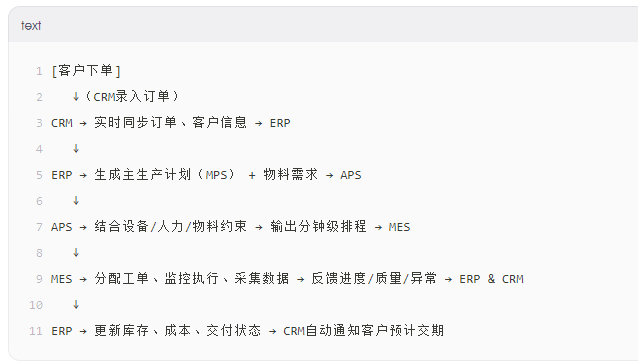
This closed loop achieves full-chain collaboration with demand-driven operation, precise planning, transparent execution, and timely feedback.
3. Typical scenarios: how does data connectivity create value?
Scenario 1: a customer places an urgent rush order. Can it be accepted?
Without connectivity: sales must call production, check inventory, and calculate delivery dates, taking two days.
With connectivity: CRM submits a rush order request, ERP verifies materials, APS simulates scheduling, returns the result within 30 seconds that the order can be accepted and delivered in seven days, and automatically updates the delivery commitment in CRM.
Scenario 2: a production abnormality occurs. How can the enterprise respond quickly?
When a piece of equipment suddenly fails, MES immediately issues an alarm, automatically triggers APS rescheduling, sends the new plan to other production lines, ERP adjusts cost estimates, and CRM pushes a delay explanation to the customer.
As the materials state: MES sends production data back to ERP, ERP updates inventory, costs, and order status, and after APS calculates material demand, ERP automatically arranges procurement.
4. The key to data connectivity: unified platform or interface patchwork?
Many enterprises adopt the approach of buying multiple systems plus manual integration, only to fall into problems such as:
Repeated data entry
Unsynchronized status
Difficult abnormality traceability
High upgrade and maintenance costs
True efficient connectivity requires consistent underlying data models, seamless business process connection, and unified master data management. For example:
Customer codes, material codes, and BOM structures are completely consistent across CRM, ERP, and MES.
Order statuses, such as confirmed, in production, and shipped, are synchronized in real time.
Cost collection is automatically completed by order without manual allocation at month-end.
To achieve efficient connectivity among ERP, MES, APS, and CRM, the key is not whether the enterprise has systems, but whether they are truly integrated. Guangdong Soonfor Software has been deeply engaged in the pan-home furnishing manufacturing industry for more than 20 years. Its independently developed F19 Furniture ERP system deeply integrates MES, APS, and CRM modules and supports:
One-click triggering of production scheduling from sales orders
Real-time updating of inventory and costs through workshop production reporting
Automatic calculation and pushing of customer delivery dates
Flexible collaboration across multiple factories, warehouses, and product categories
At present, Soonfor has provided digital solutions for business-finance integration and production-sales collaboration to more than 3,000 home furnishing enterprises, helping enterprises move from system stacking to intelligent collaboration.
Back to List >>Call Soonfor
Sales: 137-1208-6729
After-sales: 400-1166-002

Back to Top
|
Free Consultation
|
Online Support
|
Submit Request |