At present, there are many informatization management software products on the market. Different software has its own strengths, focuses on solving a certain aspect of enterprise problems, and has relatively scattered modules, lacking an overall integrated solution.
For example, some CRM management software is used for customer relationship management; some ERP management software is used for sales order management; and some MES production management software is used for production management and finished-goods management. - Modules are relatively scattered
- Obstacles to data sharing
Therefore, the various functions of the home furnishing enterprise supply chain are dispersed across different software systems, and there are obstacles to data sharing. When customers are converted into orders, synchronization cannot happen at any time, and order demand cannot be quickly translated into material-demand data to guide enterprise material procurement. Therefore, the home furnishing enterprise supply chain needs integrated management to realize data sharing, thereby improving supply-chain circulation speed, reducing unnecessary time waste, and shortening order delivery cycles. - Integrated management
- Achieve data sharing
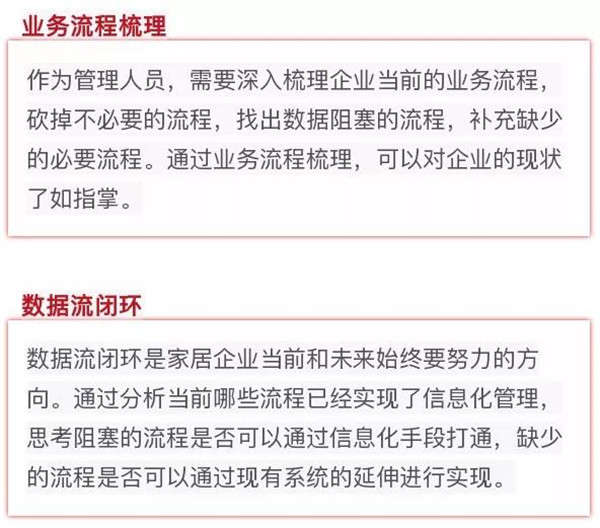
At present, home furnishing enterprises have basically adopted informatization management systems, but management remains relatively fragmented, so certain measures need to be taken to implement integrated supply-chain management. Based on Soonfor's many years of practical experience in informatization, we believe this should be considered from the following two aspects.
In short, as enterprise managers gain a full understanding of business processes, conduct deeper analysis of data flow directions, and identify where data blockages occur, they can handle the path toward integrated supply-chain management more effectively. Guided by customer demand, Soonfor integrates the sales front end, factory manufacturing, and the back-end supply chain on one platform. It connects every link from channel management, order taking and order splitting, planning and procurement, production, warehousing, delivery, installation, to after-sales service. Information flow, physical flow, and capital flow all move accurately and rapidly, effectively solving the personalized needs of various home furnishing sub-industries and meeting different production models. It also mobilizes all production links to collaborate at a high level, fully utilizes resources, and improves work efficiency. In the truest sense, it realizes closed-loop management from receiving customer demand to make-to-order production and then to warehousing, delivery, installation, and after-sales service. For furniture enterprises, by using lean production thinking to build an enterprise big-data intelligent control system and aggregating, analyzing, and monitoring various information flows, data from every link can become transparent. Only then can data be integrated, intelligently analyzed, and used for scientific decision-making to provide a basis for corporate strategic planning. On this foundation, with further support from lean production thinking, enterprises can improve and break through one link at a time, continuously make up for shortcomings, and achieve sustained improvement. In this way, the entire system becomes increasingly complete, management becomes increasingly efficient, costs become increasingly lower, and the factory becomes a truly smart factory. In the future, the informatization layout of furniture manufacturing enterprises will not be confined only to the enterprise itself. It will also bring every link in the supply chain into the enterprise's visible scope, realizing interconnection among manufacturers, equipment products, data development, and customer resources, and becoming a firm practitioner of the national Made in China 2025 strategy.
Back to List >>