

Relying on supply chain advantages and deeply implementing a project to upgrade industrial capacity is one of Shandong's key tasks for the coming period. Rizhao is the largest timber import port in China, and the city has seized this opportunity to upgrade its timber processing industry, turning logistics advantages into industrial advantages and creating new growth points for economic development.
At the Lanshan Port Area of Rizhao Port under Shandong Port Group, five cargo vessels fully loaded with imported timber are berthing and unloading at the same time, with unloading completed in about three days. These timbers that have crossed the oceans are an important part of the local industrial plan for the 15th Five-Year Plan period.
Yang Ning, deputy director of the Management Committee of Rizhao Lanshan Economic Development Zone, said that by relying on the port and fully leveraging location and transportation advantages, the zone is strengthening industrial-chain investment attraction, with a focus on deep-processing timber projects such as branded home furnishing and high-end boards, in order to build an important furniture and home furnishing material supply center in northern China and a production base for children's furniture and prefabricated wooden structures.
Rizhao Port is the largest timber import port in China. More than 360 timber vessels are unloaded here each year, and timber ships berth almost every day.
Ma Chao, chief of Inspection Section I at the Rizhao Customs Office stationed at Lanshan Port, said that in 2025 Rizhao Port imported 35 types of logs from more than 30 countries and regions, including New Zealand and Canada, with total imports exceeding 10 million cubic meters, accounting for one-third of China's total log imports.
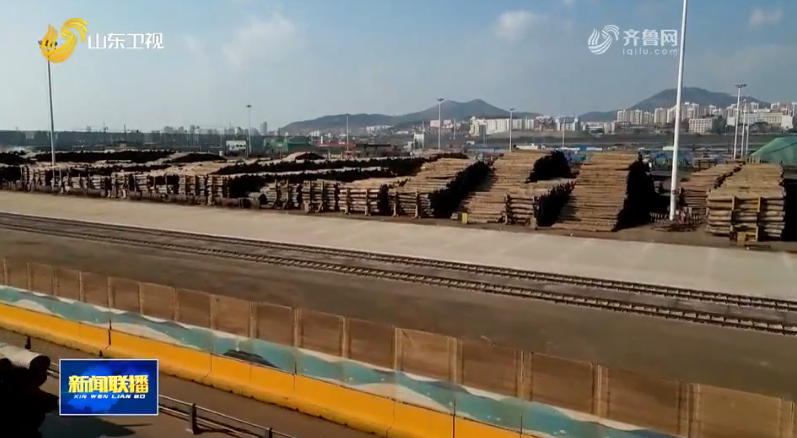
As an important hub port in the joint construction of the Belt and Road, Rizhao Port has paved a natural channel for imported timber business by virtue of its gateway advantages linking domestic and overseas markets. But in the past, little of this timber stayed in Rizhao.
Xiao Wei, deputy manager of the Third Port Affairs Branch of Shandong Port Rizhao Port Container Development Co., Ltd., told reporters that 60% of imported logs flowed to other regions. For example, spruce and hemlock from Canada were mainly sent to Northeast China for furniture manufacturing, while radiata pine from New Zealand mainly flowed to places such as Linyi and Xuzhou for the production of plywood and construction timber.
Even the small portion of timber that remained locally was mostly subjected only to simple cutting and processing before ultimately being sold to factories in other regions, resulting in very low industrial added value. Data show that the annual output value of China's deep timber processing market exceeds RMB 500 billion, indicating huge potential. Rizhao has identified integrated development of the port, industry, and city as the main direction for economic development, and deep timber processing has become a promising emerging market locally.
Wei Benlan, deputy director of the Timber Industry Investment Promotion Department of the Rizhao Lanshan Economic Development Zone Management Committee, said that in their area every part of the timber has its own mission. Large pieces are used for various furniture, boards for whole-home customization, and wooden structural building components. Smaller pieces are used to make children's toys and photo frames, while scraps can be turned into biomass fuel, wooden fasteners, and more.
While division of labor is becoming clearer, processing depth and product added value are also constantly improving. Rizhao Jinghang Forestry Products is one such timber processing enterprise. In the past, it mainly engaged in primary board processing. After several years of accumulated research and development, this year it began moving into cultural and creative wooden products and fashionable furniture.
Sun Yuanyuan, manager of the enterprise management department of Rizhao Jinghang Forestry Products Furniture Co., Ltd., said that the company has established its own design team, and annual research and development expenses account for more than 6% of revenue. In the field of cultural creativity, product added value increases significantly by adding cultural attributes and meeting the needs of young consumers.
At present, more than 400 timber processing and trading enterprises of various sizes have successively settled in the Rizhao Lanshan Economic Development Zone, forming an industrial chain of timber trade imports, sawing, drying, deep processing, and comprehensive utilization of waste materials. Ausbann, which produces home decoration boards, has also chosen to locate here and become part of the industrial chain.
Hu Bin, administrative manager of Rizhao Ausbann Decorative Materials Co., Ltd., said that upstream log processing enterprises use only the finished products from the middle sections, while Ausbann uses the leftover scraps, which are then chipped, planed, and crushed. The finished products it produces can then go downstream for laminating and edge banding, forming chain-based coordination and a transformation toward green recycling.
Thanks to the continuous improvement of the front-port, rear-park timber supply chain, more and more imported logs are choosing to enter through Rizhao, forming a virtuous cycle. This year, customs also optimized operating models in a timely manner to ensure smooth customs clearance for imported logs at the port.
Ma Chao, chief of Inspection Section I at the Rizhao Customs Office stationed at Lanshan Port, said that by relying on technological methods such as the Jinmu intelligent wood identification equipment and intelligent harmful organism identification systems, combined with service measures such as appointment-based inspection, berth quarantine, and rapid testing, seamless coordination between port operations and customs inspection has been achieved.
At present, Rizhao Port can achieve annual log imports exceeding RMB 8. billion and timber exports exceeding RMB 2. billion. Over the next five years, relying on Shandong's first national-level demonstration zone for imported timber trade and processing, the area will promote the construction of an international timber trading center, attract and cultivate a number of leading enterprises with industry influence, raise annual timber processing capacity to more than 6. million cubic meters, and achieve annual output value of more than RMB 15 billion.
Source: Qilu Net Lightning News
Back to List >>Call Soonfor
Sales: 400-1166-002
After-sales: 0769-22364912 Ext. 200

Back to Top
|
Free Consultation
|
Online Support
|
Submit Request |