

The intelligent track in the home-furnishing industry is heating up again. Leading brands such as Kuka Home, Airis, Goodnight Home, and DeRUCCI have successively released new smart mattress products, hoping to seize market opportunities through technology upgrades and ecosystem expansion. On March 23, Beijing Business Today learned that Kuka Home launched the Moon Shadow M8 Plus smart mattress, integrating multiple AI adaptive technologies such as wave-style pressure relief and snore-reduction support for different sleep scenarios. DeRUCCI also released a new series of smart beds equipped with NearLink technology, enabling seamless interaction with HarmonyOS-based appliances and adding multi-device coordination on top of sleep monitoring. In addition, Goodnight Home and Airis have also introduced smart mattress products.
Public data shows that the smart mattress industry continues to maintain strong growth, with market size exceeding 18 billion yuan in 2025 and the share of high-end products continuing to rise. Industry observers believe smart mattresses and smart sofas have become the core growth track for breaking through bottlenecks in the upholstered-furniture industry and a major lever for intelligent transformation. Looking ahead, the industry will continue to deepen the hardware-plus-data-plus-service model in 2026, and smart mattresses are expected to move from a premium niche into broader mass adoption,driving the entire industry toward healthier and more intelligent upgrading.
Accelerating smart mattress deployment
As digital lifestyles continue to spread, consumers are increasingly eager for healthier sleep. However, the 2026 Sleemon China Sleep Index Report shows that sleep quality is still declining.
According to the report, China's sleep index peaked at 68.74 points in 2024 and fell back to 63.15 points in 2025. The sleep-quality score dropped to 60.14, the lowest level since 2021. Against this backdrop, many companies are speeding up their deployment in the smart mattress market to offer consumers better sleep experiences.
It is worth noting that companies are taking different technical approaches. While Kuka Home focuses on AI adaptive comfort, Airis starts from the regulation of the sleep microenvironment. DeRUCCI promotes intelligent development through a hardware-plus-data-plus-service technology loop, while Tisipur, under Goodnight Home, is more oriented toward broad consumer demand.
An Airis executive said the company has long adhered to the concept of healthy deep sleep and focused on how to truly increase deep-sleep duration. Its MESHTECH sleep microenvironment control system on the Apollo mattress was validated through a series of experiments, including sleep-structure testing and temperature-and-humidity testing at the human-bed interface. The results showed that microenvironment optimization can positively affect sleep onset, deep-sleep proportion, and sleep continuity, and these capabilities have been translated into actual products.
Beijing Business Today also learned that DeRUCCI launched the Harmony Selected DeRUCCI Smart Bed Pro H-DESIGN. Built on a NearLink-based digital foundation, it can interact seamlessly with HarmonyOS ecosystem devices such as lighting, curtains, and air conditioners, helping solve the device-island problem in smart homes. Through this differentiated AI-plus-ecosystem path, DeRUCCI is driving deeper integration between smart mattresses and whole-home intelligence.
Regarding future development, Yao Jiqing, vice chairman and president of DeRUCCI Group, said at the launch event that DeRUCCI officially introduced its All In AI strategy in 2025 and became a partner of Harmony Selected. The company will continue to take AI as the core and deepen sleep research in the future.
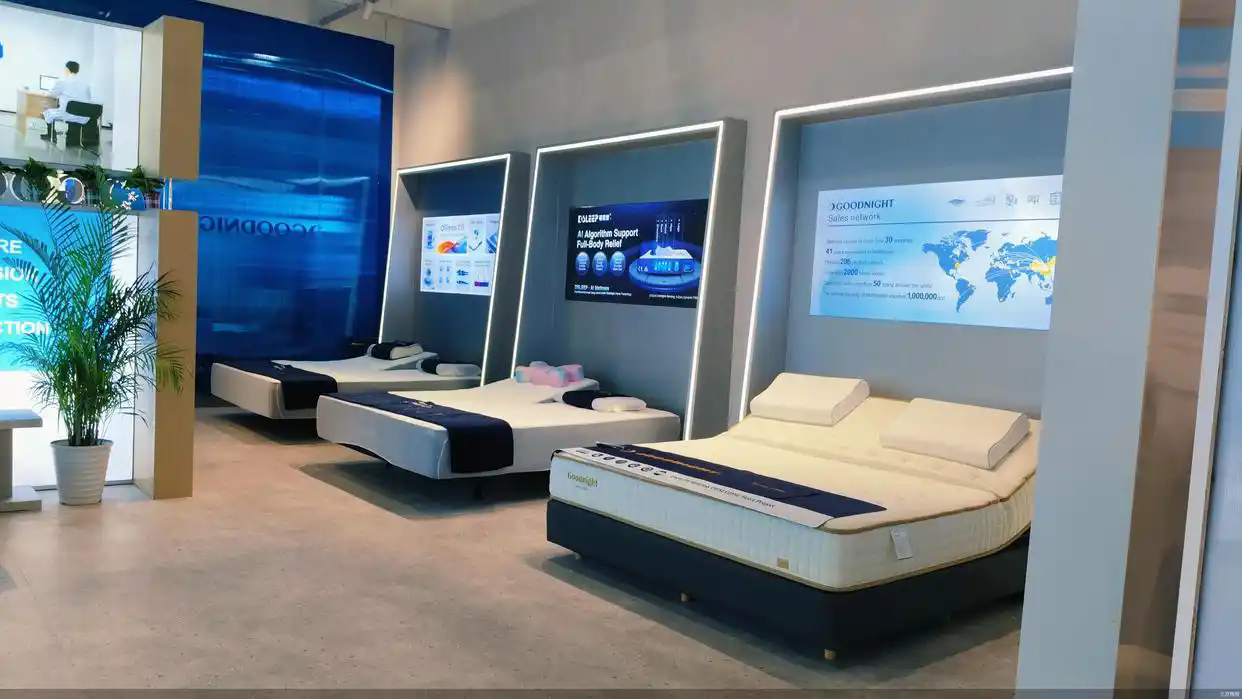
Tisipur AI mattresses under Goodnight Home have entered the smart mattress track with strong adaptability and cost performance, offering multiple products for different groups of users. According to company management, the operating team comes from the home-appliance and internet sectors, and its R and D system is supported by universities and spinal-health experts, enabling products to be internet-oriented, AI-driven, and capable of continuous learning and optimization from the architectural level rather than being simple traditional mattresses with added electronic functions.
Multiple factors are driving growth
Behind the heating-up of the smart mattress track is the continued rise of consumer health awareness. During visits to retail terminals, Beijing Business Today found that consumers are no longer concerned only with traditional indicators such as firmness. Interest in sleep quality, material safety, and intelligent functions has grown significantly.
In fact, the number of consumers facing sleep problems is substantial. The sleep report shows that many people in China have had a difficult year for sleep. Although 70.5. percent of people believe they sleep for the standard 6. to 8. hours, only 12.3. percent feel fully rested after waking up, and more than 40 percent say they do not feel recovered at all.
The growing concern for sleep quality has brought new opportunities to the smart mattress market. At present, the upholstered-furniture industry is shifting from traditional manufacturing toward intelligent manufacturing. Rapid advances in the internet of things, artificial intelligence, and sensor technology are continuously upgrading smart mattresses in sleep monitoring and adaptive adjustment while also reducing development and production costs.
Policy support is also accelerating the sector. In September 2025, the State Administration for Market Regulation approved and released the national standard for smart mattresses, which took effect on March 1. this year and established unified requirements for intelligence, functionality, and safety.
Opportunities and challenges coexist
With technology developing quickly, the smart mattress sector is expected to become more diversified, intelligent, and ecosystem-oriented. On the one hand, AI algorithms and big data can deliver more precise sleep monitoring and personalized health intervention. On the other hand, companies still need to balance technology cost, user education, and product standardization as the category moves toward scale.
Overall, the warming smart mattress track reflects the combined effect of consumption upgrading, technological progress, and the transformation of the upholstered-furniture industry. As these factors continue to reinforce one another, the industry is likely to accelerate its move from traditional manufacturing to healthier and more intelligent development.
Back to List >>Call Soonfor
Sales: 400-1166-002
After-sales: 0769-22364912 Ext. 200

Back to Top
|
Free Consultation
|
Online Support
|
Submit Request |