

Entering 2026, the curtain has officially opened on China's 15th Five-Year Plan. The goal written into the plan of building safe, comfortable, green, and smart good houses undoubtedly anchors the direction and clarifies the path for upgrading living quality over the next five years.
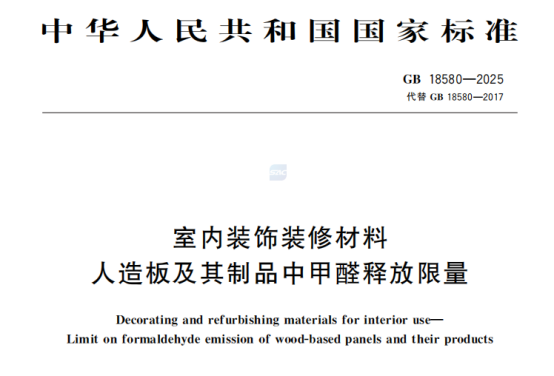
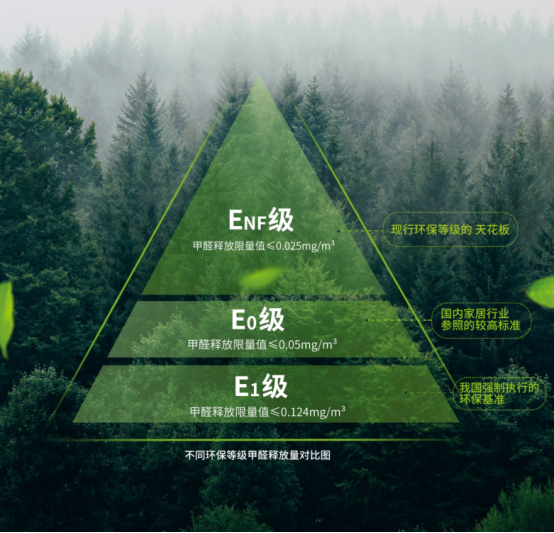
As a core material for home decoration, the environmental upgrade of wood-based panels has become a key link in practicing good house standards. The newly released 2025 national standard GB 18580-2025, Formaldehyde Emission Limits in Wood-Based Panels and Their Products for Indoor Decoration and Renovation Materials, includes E0 grade in the scope of mandatory national standards for the first time. It clearly stipulates that from June 1, 2026, wood-based panel substrates must meet E1 grade standards, with formaldehyde emission not exceeding 0.124 mg/m3, while wood-based panel products such as decorative wood-based panels, wood flooring, and wooden doors must meet E0 requirements, with formaldehyde emission not exceeding 0.05 mg/m3.
This means that E1-grade decorative wood-based panels will completely exit the domestic market, while E0-grade and ENF-grade decorative wood-based panels will become mainstream, injecting green genes into good house construction and accelerating the iterative upgrading of residential environmental quality.
In fact, China's standards for formaldehyde emission from wood-based panels and their products have always been iteratively optimized, with limits gradually tightened.
In 2001, China first issued the mandatory national standard GB 18580-2001, Formaldehyde Emission Limits in Wood-Based Panels and Their Products for Indoor Decoration and Renovation Materials. It respectively specified that E1-grade panels could be directly used indoors, while E2-grade panels could be used indoors only after surface treatment, establishing the industry's initial environmental bottom line.
The mandatory national standard issued in 2017 further tightened requirements by removing E2 grade and raising the formaldehyde emission limit for E1 grade, setting its limit at 0.124 mg/m3. This forced a number of small and medium-sized enterprises that failed to meet environmental standards to exit the market. The recommended national standard issued in 2021 divided grades into E1 and E0, with a limit not exceeding 0.05 mg/m3, and proposed ENF grade for the first time, with a limit not exceeding 0.025 mg/m3, marking that China's formaldehyde emission requirements for wood-based panels and their products had reached an internationally leading level.
It is not difficult to see that as the wood-based panel industry enters its second half, shifting from scale expansion to efficiency improvement, from low-price internal competition to value cultivation, and from extensive management to lean operation, product access thresholds continue to rise and regulatory rules become increasingly detailed and complete. For wood-based panel enterprises, only by anchoring the main line of green development, adhering to the environmental quality bottom line, and focusing on high-end, intelligent, and green development can they achieve long-term high-quality development.
Source: News Department of China Wood Industry Network
Back to List >>Call Soonfor
Sales: 400-1166-002
After-sales: 0769-22364912 Ext. 200

Back to Top
|
Free Consultation
|
Online Support
|
Submit Request |