

In January 2026, the Industrial Development Planning Institute of the National Forestry and Grassland Administration, also known as the Forestry Industry Planning and Design Institute, and the China National Forest Products Industry Association jointly completed statistics on changes in China's wood-based panel production capacity in 2025. They also conducted statistical analysis of new projects at the beginning of 2026 and, on that basis, made trend judgments. The 2025 report on changes in China's plywood production capacity and related trend judgments is now officially released.
By the end of 2025, China had more than 5,010 plywood product manufacturers, with total production capacity of about 246 million cubic meters per year, up 11.3. percent from the end of 2024. Average production capacity per enterprise was about 49,100 cubic meters per year.
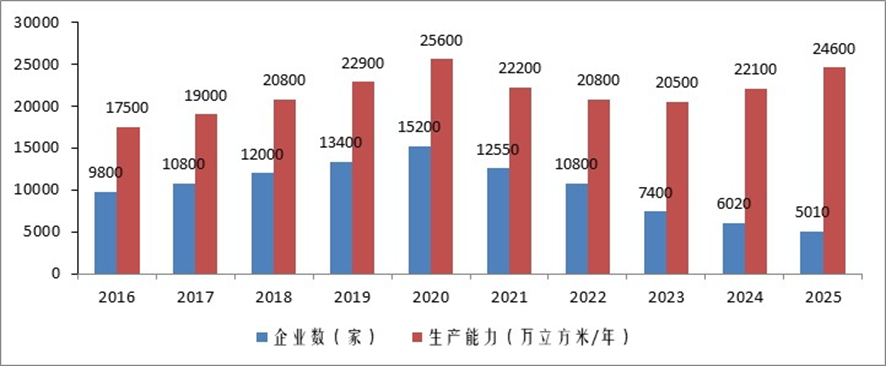
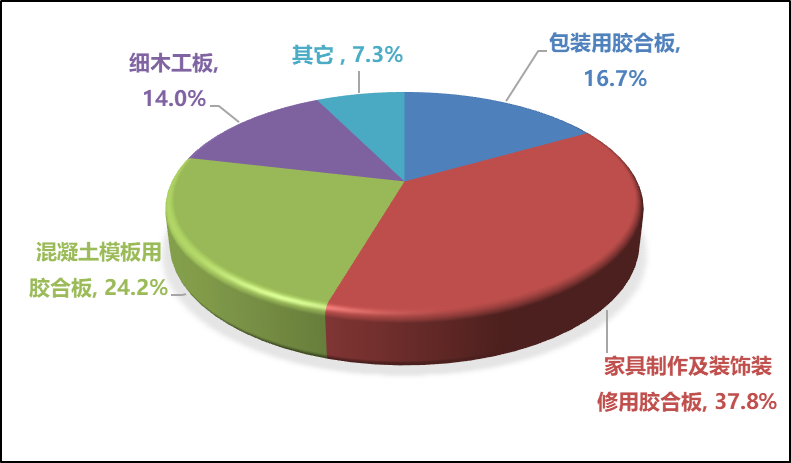
China's plywood industry shows a trend of fewer enterprises, rising total production capacity, and continuous growth in average enterprise capacity. Plywood production capacity for furniture manufacturing and decoration accounts for about 37.8. percent of China's total plywood product capacity, with supply and demand relatively balanced. Plywood for concrete formwork accounts for about 24.2. percent of total capacity, and overcapacity remains prominent. Packaging plywood capacity has declined further, accounting for about 16.7. percent. Blockboard accounts for about 14.0. percent, while other products such as plywood substrate for engineered wood flooring, container flooring plywood, laminated veneer lumber, specialty plywood, and shaped plywood together account for about 7.3. percent.
Plywood product manufacturers nationwide are distributed across 26 provinces, municipalities, and autonomous regions. Among them, Guangxi and Shandong each have annual production capacity exceeding 70 million and 60 million cubic meters respectively. Jiangsu's annual production capacity is close to 30 million cubic meters, while Anhui, Hebei, and Fujian each exceed 10 million cubic meters.
Among prefecture-level administrative regions, Linyi has annual production capacity exceeding 50 million cubic meters, Guigang exceeds 20 million cubic meters, and Suqian, Langfang, Laibin, Xuzhou, and Liuzhou each exceed 10 million cubic meters. Among county-level administrative regions, Feixian County of Linyi has annual production capacity close to 30 million cubic meters, while Lanshan District of Linyi, Gangnan District of Guigang, and Shuyang County of Suqian each exceed 10 million cubic meters.
Guangxi currently has 1,200 plywood product manufacturers distributed across 14 prefecture-level cities, with combined production capacity of about 76.10 million cubic meters per year, accounting for 30.9. percent of the national total and continuing to rank first in China. Guigang remains the largest plywood product production base in southern China, with total production capacity of 25.80 million cubic meters per year, accounting for about 33.9. percent of Guangxi's total. Gangnan District has production capacity of about 13.50 million cubic meters per year, accounting for 52.3. percent of the city's total. Laibin and Liuzhou have entered the ranks of prefecture-level cities with capacity exceeding 10 million cubic meters, reaching 11.00 million and 10.20 million cubic meters per year respectively.
Shandong currently has 1,340 plywood product manufacturers distributed across 15 prefecture-level cities except Jinan, with combined production capacity of about 65.70 million cubic meters per year, accounting for 26.7. percent of the national total and maintaining second place nationwide. The number of plywood product enterprises in Linyi has further decreased, but production capacity has grown to 54.60 million cubic meters per year, accounting for 83.1. percent of the provincial total and continuing to maintain its position as the largest plywood product production base in Shandong and even nationwide. Feixian County has production capacity of about 28.20 million cubic meters per year, accounting for 51.6. percent of Linyi's total, while Lanshan District has capacity of about 17.40 million cubic meters per year, accounting for 31.9. percent.
Jiangsu currently has 620 plywood product manufacturers distributed across 11 prefecture-level cities except Changzhou and Zhenjiang, with combined production capacity of about 28.60 million cubic meters per year, accounting for 11.6. percent of the national total and maintaining third place nationwide. Suqian has production capacity of about 13.20 million cubic meters per year, accounting for about 46.2. percent of the provincial total, and Shuyang County has capacity of about 11.70 million cubic meters per year, accounting for 88.6. percent of Suqian's total. Xuzhou has production capacity of about 10.40 million cubic meters per year, accounting for about 36.4. percent of Jiangsu's total.
Anhui currently has 280 plywood product manufacturers distributed across 15 prefecture-level cities except Tongling, with combined production capacity of 13.50 million cubic meters per year, accounting for 5.5. percent of the national total and maintaining fourth place nationwide. Suzhou and Lu'an are the province's main plywood product production clusters, accounting for 34.8. percent and 30.4. percent of provincial capacity respectively.
Hebei currently has 300 plywood product manufacturers distributed across eight prefecture-level cities except Tangshan, Chengde, and Zhangjiakou, with combined production capacity of about 12.30 million cubic meters per year, accounting for 5.0. percent of the national total and maintaining fifth place nationwide. Langfang has production capacity of about 11.20 million cubic meters per year, accounting for about 91.1. percent of Hebei's total.
Fujian currently has 250 plywood product manufacturers distributed across all nine prefecture-level cities in the province, with combined production capacity of about 10.20 million cubic meters per year, accounting for 4.1. percent of the national total and maintaining sixth place nationwide. Zhangzhou is the province's main plywood product production cluster, accounting for about 61.8. percent of provincial capacity.
By the end of 2025, among China's 5,010 plywood product manufacturers, 314 were national high-tech enterprises, 447 were national technology-based small and medium-sized enterprises, and 26 were national key forestry leading enterprises. Nationwide, 609 plywood product manufacturers had annual production capacity exceeding 100,000 cubic meters, including 189 large manufacturers and enterprise groups with combined production capacity of 37.39 million cubic meters per year, accounting for about 15.2. percent of total capacity. Among them, two manufacturers and enterprise groups had annual production capacity reaching or exceeding 500,000 cubic meters.
At the beginning of 2025, nearly 1,600 plywood product manufacturers were under construction nationwide. Except for Beijing, Shanghai, Tianjin, Qinghai, Ningxia Hui Autonomous Region, and Tibet Autonomous Region, all other 25 provinces and autonomous regions had plywood manufacturers under construction.
By the end of 2025, China had issued a total of 1,187 production licenses for products including ordinary plywood, flame-retardant plywood, blockboard, and flame-retardant blockboard.
At this stage, China's plywood industry as a whole shows a situation in which supply capacity exceeds consumer demand. The industry must continue adjusting its product structure to adapt to changes in market demand and improve the quality of industrial development.
Source: China Wood-Based Panels
Back to List >>Call Soonfor
Sales: 400-1166-002
After-sales: 0769-22364912 Ext. 200

Back to Top
|
Free Consultation
|
Online Support
|
Submit Request |